Why are there five gases included in the Papp engine gas mix?

http://upload.wikimedia.org/wikipedia/commons/8/82/Paschen_Curves.PNG
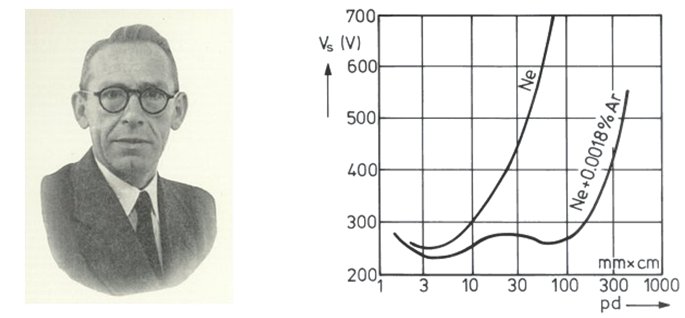
In 1927 Penning (Figure above) measured the breakdown voltage of a neon
discharge as a function of pressure and distance between the electrodes.
The result is known as the Paschen Curve, after Paschen who had discovered
that the breakdown voltage is a function of the product of gas pressure and
electrode distance.

Penning found that his results were only consistent if he used extremely
pure neon. Minute traces of other gases, such as argon, lowered the
breakdown voltage considerably (Fig. below).

http://www.dos4ever.com/Z550M/penning3.jpg


Penning knew about the work of Dorgelo on metastable states. Metastable
states in Neon had been discovered by Meissner in 1925. These are energy
states well above ground state, from which all transitions to lower states
are forbidden.

Atoms in these metastable states generally return to ground state by either
going through a higher energy state or by a collision. As a result
metastable states can have lifetimes in the order of a millisecond.

Penning proved that what was happening in his gas mixtures was that before
the electrons have sufficient energy to ionize the neon, they can excite
neon atoms, and these excited atoms can pass into metastable states.

Because of their relatively long lifetime, there is a high probability of
collision with one of the impurity atoms. Argon has an ionization potential
below the energy of metastable neon, so argon atoms will ionize leading to
the initiation of the discharge. Such a gas mixture became known as a
Penning Gas. It can be used to lower the breakdown voltage of a discharge
tube, or to make the breakdown less dependent on the inter-electrode
distance.
In summation, by providing a cascading discharge mechanism, the five gas
Papp mix makes the spark electrode discharge distance far less of a factor
in spark formation than a single pure gas or a limited combination of gases
and this mix lowers the voltage required to produce a discharge.

The more gas impurities there are, the higher is the probability of a
collision with one or more of the impurity atoms.

One experiment that DGT might try is to add a small amount of noble gas to
their hydrogen envelope to decrease required spark power and increase spark
plug life. IMHO, Xeon would be best.


Cheers:    Axil


On Fri, Sep 14, 2012 at 10:46 AM, ecat builder <[email protected]>wrote:

> Hi Vortex,
>
> Some updates on Papp development.. Which most of you know is a noble gas
> that is charged (by RF/spark) and drives a piston with an unexplained (?)
> force. Harvesting the force and residual energy to produce overunity power
> remains to be seen.
>
> http://peswiki.com/index.php/Talk:Directory:Plasma_Energy_Controls_Plasma_Expansion_Motor
>
>
>
> An open source Papp Engine based on Bob's design is being built by a 26 yr
> old whiz named Russ.
> He has made great progress in just a few weeks-- a cylinder based on Bob's
> test unit, spark generator, gas system, and more.
> I'm sure he'll be looking for ideas on how to mix and test noble gas
> mixtures.
>
> http://rwgresearch.com/
> https://www.youtube.com/user/rwg42985?feature=g-user-u
> http://www.open-source-energy.org/forum/showthread.php?tid=659
> Bob is chiming in with feedback, which is great to see. The forum is at 12
> pages and is filled with interesting tidbits.
>
>
> Here is a (self-taught?) Dannel Roberts and his visit to Bob's shop.
> http://www.youtube.com/watch?feature=player_embedded&v=_zWJNyoFgJM
> Starting at 22:40 is Robert's theory of how the Papp engine creates a
> bang...
>
>
> Chuck (a LENR replicator) received his Popper Kit from John. It contains
> 15 pages of design/build notes and has a signal generator to drive 2
> included spark coils.
> http://www.youtube.com/watch?v=_lFt_q69dxk&feature=plcp
>
> Bob Rohner has also produced a few new movies, one warning of the
> potential dangers of building a popper.. another showing the system running
> without a coil, dispelling the thought that the coil could be the source of
> the force, showing that compressed air is not used.
> http://www.rohnermachine.com/pagedocuments.html
> https://www.youtube.com/user/bjrohner?feature=g-user-u
>
> All very interesting, but a lot of power is going in (300 joules?) so a
> lot of work, luck, and miracles may still be needed.
>
> - Brad
>
>
>