On Fri, Aug 23, 2019 at 10:24:47PM -0700, Philip Thrift wrote:
>
>
> On Friday, August 23, 2019 at 5:54:17 PM UTC-5, Russell Standish wrote:
>
>     On Wed, Aug 21, 2019 at 10:28:39AM +0200, Bruno Marchal wrote:
>     >
>     >     On 20 Aug 2019, at 19:38, Philip Thrift <[email protected]> wrote:
>     >
>     >
>     >
>     >     The reason to suspect that arithmetic comes from matter (M→A) vs.
>     matter
>     >     comes from arithmetic (A→M) is that with A→M there many Ms.
>     >
>     >
>     > On the contrary: Arithmetic (A) explains why there is many geographies
>     and
>     > history, but only one physics, the same fr all universal machine. That
> is
>     due
>     > to the fact that Physics (Matter, M) emerges from the first person
>     > indeterminacy on *all* computations.
>     > So A explains why there is only one M possible, and why the physical
>     reality is
>     > the same for all universal machine/number.
>     > With A, the physical laws are justified being laws, and we get some
>     criteria
>     > (lacking in physics+physicalism) to distinguish physics and geography.
>
>     This answer is a bit glib IMHO. In some ways it echos the statements I
>     give in section 9.3 of my book "Theory of Nothing", but which I freely
>     admitted I felt were provisional and too hand-wavy. However, I believe
>     that Markus Mueller has since provided an answer in the form of a
>     theorem (Thm 2.3 "Emergence of an Objective Reality") in his paper
>     arXiv: 1712.01816.
>
>     That paper to me is probably the most significant result in this area
>     since I published my book.
>
>     Cheers
>
>     --
>
>     ------------------------------------------------------------
>     ----------------
>     Dr Russell Standish                    Phone 0425 253119 (mobile)
>     Principal, High Performance Coders
>     Visiting Senior Research Fellow        [email protected]
>     Economics, Kingston University         http://www.hpcoders.com.au
>
>
>
> So how does one get from (simple)
>
>    https://arxiv.org/pdf/1712.01816v1.pdf
>
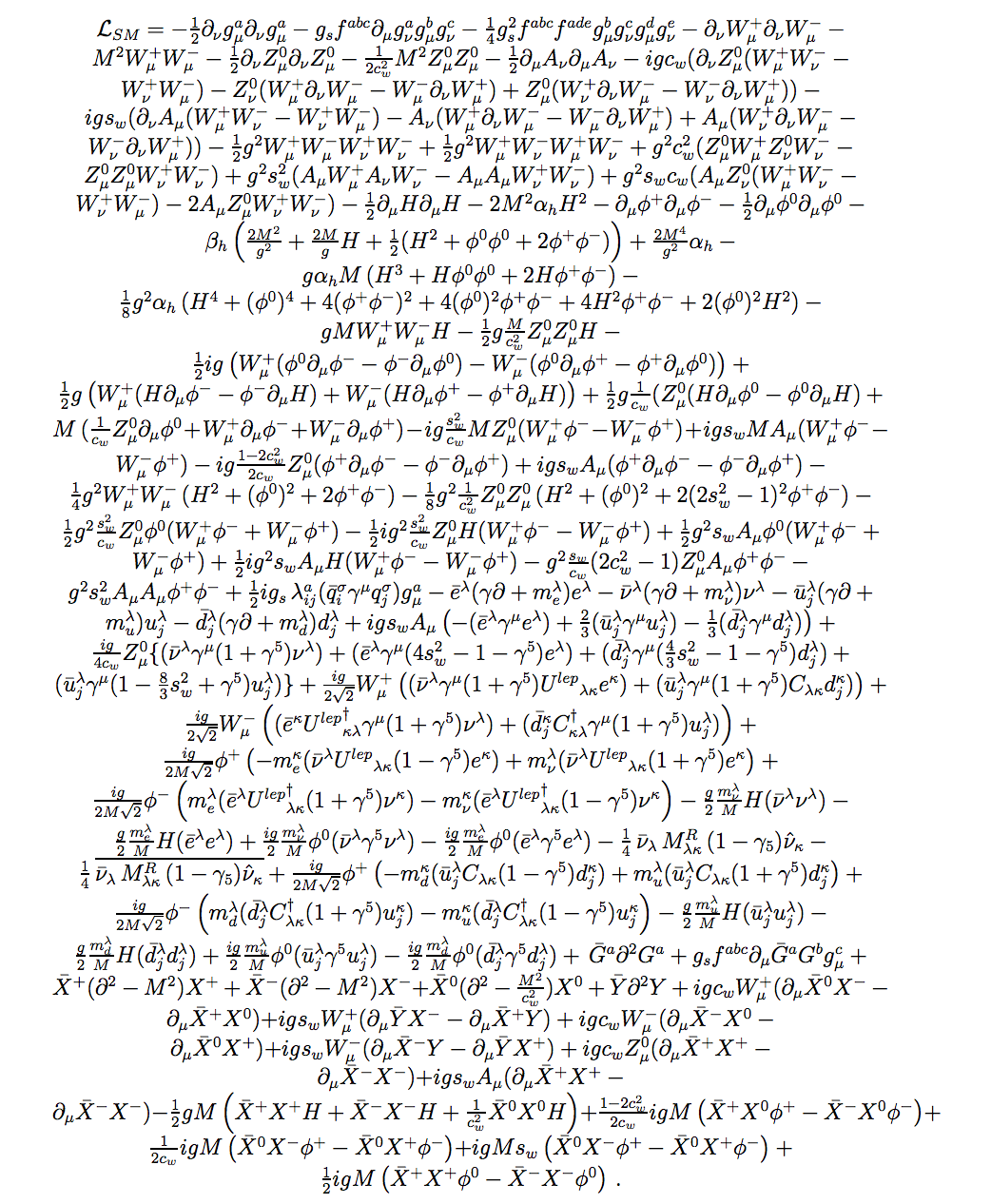
> to (complex)
>
>
> https://www.sciencealert.com/images/Screen_Shot_2016-08-03_at_3.20.12_pm.png
>    (the Lagrangian Standard Model equation)
>
> ?
>
> @philipthrift
>
A partial answer is explored in Stenger's "Comprehensible Cosmos". In
brief, its a combination of symmetries and symmetry breaking. But, as
they say, the devil is in the details.

Cheers
--

----------------------------------------------------------------------------
Dr Russell Standish                    Phone 0425 253119 (mobile)
Principal, High Performance Coders
Visiting Senior Research Fellow        [email protected]
Economics, Kingston University         http://www.hpcoders.com.au
----------------------------------------------------------------------------

--
You received this message because you are subscribed to the Google Groups
"Everything List" group.
To unsubscribe from this group and stop receiving emails from it, send an email
to [email protected].
To view this discussion on the web visit
https://groups.google.com/d/msgid/everything-list/20190825042635.GG2402%40zen.