On Apr 14, 7:03 pm, "David B. Benson" <[EMAIL PROTECTED]> wrote:
> On Apr 13, 5:53 pm, jdannan <[EMAIL PROTECTED]> wrote:
>
> > ...
> > (eg
> > tropical iris).
>
> Aha!
>
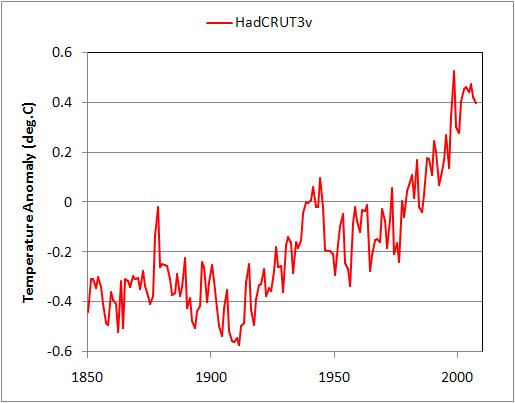
> Another way to consider the climate sensitivity to CO2 is to consider
> the change in temperatures
>
> http://tamino.files.wordpress.com/2008/04/t3v.jpg
>
> since the beginning of the Keeling curve data (which I think is 1958
> CE).  Both the global temperatures and the atmospheric CO2 are in an
> uptrend and a correlation coeficient could be established.  So
> irrespective of any iris effect, the net positive forcing can be
> statistically determined.
>
> I suppose somebody has already done this?

I see this thread is not explicitly about sensitivity.  It is just
another that James has taken over to address his pet subject :-)

Anyway david Benso wrote:
> I am under the impression that D-O events do not occur during
> interglacials.  [Leaving aside the question of how 'interglacial' is
> to be precisely defined.]

If you define inter-glacials as the time of maximum temperature
between glacials, then by definition they do not show warm events.
Thus your claim tha D-O event do not happen is true during any past
inter-glacial.  However, it is invalid to argue that since we are now
in an interglacial we are at a period of maximum temperature.  We know
that by adding CO2 we are raising the global temperature and so we are
not at the maximum temperature. This may seem facetious, but it leads
to two more important points.

Firstly, in the Northern Hemisphere the change to this inter-glacial,
and possibly to earlier ones happened abruptly.  Could it be that in
the NH that is the way warmings happen?  Could it be that the
increasing CO2 will cause a sharp warming not a slow steady rise in
temperature.  The climate is a non-linear dynamical system.  We do not
know how the climate will respond to the increase in CO2 any more than
by how much.

Secondly, on a more practical level, Gildor & Tziperman (2003)
http://www.seas.harvard.edu/climate/eli/reprints/Gildor-Tziperman-2003.pdf
propose that the rapid changes are caused by sea ice.  They conclude
"If sea ice is to be implicated for the abrupt past climate
transitions, then we cannot expect future global warming to result in
as strong or as rapid climate transitions as were observed during the
LGM."  However, there still exist two sea ice sheets, the Arctic Ocean
in the NH and the Weddell Sea in the SH. So there is still a
possibility for a rapid change if either of those should suddenly
disappear.

Thirdly, during the Eemian global temperatures were higher than
today's and it is unlikely that the Arctic sea ice was present since
much of the Greenland ice had melted.  Thus a rapid change to Eemian
conditions is quite feasible, without contadicting you claim that D-O
events do not happen during inter-glacial.  It depends whether you
define the Holocene as a normal inter-glacial or as a cold inter-
glacial.

OTOH, if it is correct that we only see rapid changes during glacials,
then that implies that climate sensitivity during glacials is
different from that during inter-glacials. Whichever is true, climate
sensitivity is a chimera!

One final point, just to return to the subject of this thread. We know
that the Eemian was warmer than the Holocene, so how could that happen
if Spencer's Iris operates? Surely that would have prevented
temperatures in the Eemian rising above those we now experience?

Cheers, Alastair.

--~--~---------~--~----~------------~-------~--~----~
You received this message because you are subscribed to the Google Groups
Global Change ("globalchange") newsgroup. Global Change is a public, moderated
venue for discussion of science, technology, economics and policy dimensions of
global environmental change.

Posts will be admitted to the list if and only if any moderator finds the
submission to be constructive and/or interesting, on topic, and not
gratuitously rude.

To post to this group, send email to [email protected]

To unsubscribe from this group, send email to [EMAIL PROTECTED]

For more options, visit this group at
http://groups.google.com/group/globalchange
-~----------~----~----~----~------~----~------~--~---