On 15/04/2008, David B. Benson <[EMAIL PROTECTED]> wrote:
>
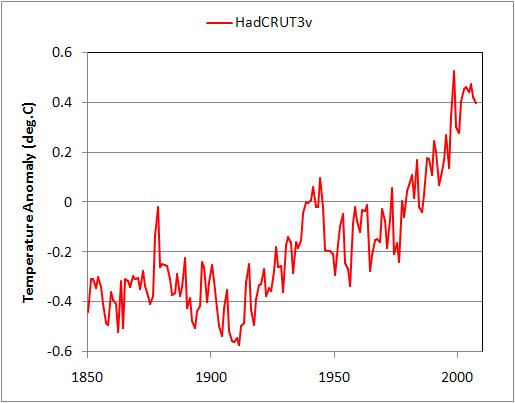
>  Another way to consider the climate sensitivity to CO2 is to consider
>  the change in temperatures
>
>  http://tamino.files.wordpress.com/2008/04/t3v.jpg
>
>  since the beginning of the Keeling curve data (which I think is 1958
>  CE).  Both the global temperatures and the atmospheric CO2 are in an
>  uptrend and a correlation coeficient could be established.  So
>  irrespective of any iris effect, the net positive forcing can be
>  statistically determined.
>
>  I suppose somebody has already done this?
Yes, it's a standard approach, many people have done this (Richard Tol
may have been one of the first, back in 1998 - any bidders for an
older analysis?). However, it is hard to distinguish between a
moderately high sensitivity, and a very high sensitivity, by this sort
of analysis (which he noted, and many others have rediscovered since).

James

--~--~---------~--~----~------------~-------~--~----~
You received this message because you are subscribed to the Google Groups
Global Change ("globalchange") newsgroup. Global Change is a public, moderated
venue for discussion of science, technology, economics and policy dimensions of
global environmental change.

Posts will be admitted to the list if and only if any moderator finds the
submission to be constructive and/or interesting, on topic, and not
gratuitously rude.

To post to this group, send email to [email protected]

To unsubscribe from this group, send email to [EMAIL PROTECTED]

For more options, visit this group at
http://groups.google.com/group/globalchange
-~----------~----~----~----~------~----~------~--~---