Nice response -- here's mine

Do not pretend to know my name
The words I use are weak and lame

They cannot tell from whence they came

They don’t pretend to know my name

+

There is no reason to say more

I do not know what this is for

There is no why there’s no wherefore

Why is there reason to say more

+

I have an inkling that is all

Our weather changes spring to fall

Still no one know’s what’s past time’s wall

save for an inkling that is all


amazon.com/author/stephenrose

On Wed, Feb 21, 2018 at 5:38 PM, Jerry Rhee <[email protected]> wrote:

> Dear Helmut,
>
>
>
> You said,
>
> All that is a reflection in another mirror, a bit further away. Solipsism
> is assuming an endless series of mirrors behind mirrors. Sounds like hell.
> Can you show a way out..
>
>
>
> I would presume based on our past experiences that you wouldn’t care for
> me to show you a way out, but rather, for me to say how Peirce would show a
> way out.
>
>
>
> I am not sure what the following means but it is in *Some Consequences*,
> and many scholars, pragmatists, pragamticists, have already spoken on its
> connected themes.
>
>
> I suppose one could argue that whether they had anything relevant to say
> would depend on whether the reader makes any effort to follow their
> argument, rather than being satisfied that he can work it out on his own by
> reflecting on the issues, himself, in isolation.  To help matters, though,
> Peirce did follow up with *Man's Glassy Essence, *'tho it adds to the
> amount of things one has to think about..
>
> In any case, here it is:
>
>
> The individual man, since his separate existence is manifested only by
> ignorance and error, so far as he is anything apart from his fellows, and
> from what he and they are to be, is only a negation. This is man,
>
>
> ". . . proud man,
> Most ignorant of what he's most assured,
> His glassy essence."
>
>
>
> As for Peirce, he also says this, of course:
>
>
>
> The apostle of Humanism says that professional philosophists “have
> rendered philosophy like unto themselves, abstruse, arid, abstract, and
> abhorrent.” But I conceive that some branches of science are *not* in a
> healthy state if they are not abstruse, arid, and abstract, in which
> case, like the Aristotelianism which is this gentleman’s particular bête
> noire, it will be as Shakespeare said (*of it*, remember)
>
>
>
> “Not harsh and crabbed, as dull fools suppose,
>
> But musical as is Apollo’s lute,” etc.
>
>
>
> I hope I have led you to a way out,
>
> Jerry R
>
>
> On Wed, Feb 21, 2018 at 4:10 PM, Helmut Raulien <[email protected]> wrote:
>
>> Jerry,
>> when a mirror appears in the field of sight, then the eye can see itself.
>> Its owner may ask him/herself: What is behind that mirror? But the mirror
>> is there, so behind it is also what is behind the eye. But the world too.
>> So it is the (eye-owner´s) world, and the owner of the world, being a part
>> of it. All that is a reflection in another mirror, a bit further away.
>> Solipsism is assuming an endless series of mirrors behind mirrors. Sounds
>> like hell. Can you show a way out, for Quasimodo of Notre-Dame, and us all?
>> Something like transcendence or what ever?
>> Best,
>> Helmut
>>
>> 21. Februar 2018 um 20:53 Uhr
>> *Von:* "Jerry Rhee" <[email protected]>
>>
>>
>> Dear list,
>>
>>
>>
>> Speaking of the person who sees the vase, who happens to be a Quasi-mind:
>>
>>
>>
>> *5.6          *
>>
>> *The limits of my language** mean the limits of my world.*
>>
>>
>>
>> *5.61*
>>
>> Logic fills the world: the limits of the world are also its limits.
>>
>> We cannot therefore say in logic: This and this there is in the world,
>> *that* there is not.
>>
>>
>>
>> For *that* would apparently presuppose that we exclude certain
>> possibilities, and this cannot be the case since otherwise logic must get
>> outside the limits of the world: that is, if it could consider these limits
>> from the other side also.
>>
>>
>>
>> What we cannot think, *that* we cannot think: we cannot therefore *say* what
>> we cannot think.
>>
>>
>>
>> *5.62*
>>
>> *This remark provides a key to the question, to what extent solipsism is
>> a truth.*
>>
>> In fact what solipsism *means*, is quite correct, only it cannot be
>> *said*, but it shows itself.
>>
>> That the world is *my* world, shows itself in the fact that the limits
>> of the language (*the* language which I understand) mean the limits of
>> *my* world.
>>
>>
>>
>> *5.63*
>>
>> I am the world. (The microcosm.)
>>
>>
>>
>> *5.633*
>>
>> *Where in* the world is a metaphysical subject to be noted?
>>
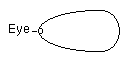
>> You say that this case is altogether like that of the eye and the field
>> of sight. But you do *not* really see the eye.
>>
>> And from nothing *in the field of sight* can it be concluded that it is
>> seen from an eye.
>>
>>
>>
>> *5.6331*
>>
>> For the field of sight has not a form like this:
>>
>> http://www.kfs.org/jonathan/witt/f56331.gif
>>
>>
>>
>> *5.64*
>>
>> *Here we see that solipsism strictly carried out coincides with pure
>> realism*. The I in solipsism shrinks to an extensionless point and there
>> remains the reality co-ordinated with it.
>>
>>
>>
>> *There is in the dictionary a word, solipsism, meaning
>> the belief that the believer is the only existing person. Were anybody to
>> adopt such a belief, it might be difficult to argue him out of it. But when
>> a person finds himself in the society of others, he is just as sure of
>> their existence as of his own, though he may entertain a metaphysical
>> theory that they are all hypostatically the same ego**.*
>>
>>
>>
>> Hth,
>>
>> Jerry R
>>
>> On Wed, Feb 21, 2018 at 1:01 PM, Jon Alan Schmidt <
>> [email protected]> wrote:
>>>
>>> Edwina, List:
>>>
>>> 1.  A hypothesis is not intended to be an argument.  However, your point
>>> about providing multiple terms for the same concept is well-taken.  With
>>> that in mind, I now see *three *interpretive possibilities for Peirce's
>>> statement, "Such perfect sign is a quasi-mind.  It is the sheet of
>>> assertion of Existential Graphs."
>>>
>>>    - A perfect Sign and a Quasi-mind are one and the same, and the
>>>    Sheet of Assertion is an example.
>>>    - A perfect Sign and the Sheet of Assertion are one and the same,
>>>    but there are other kinds of Quasi-minds.
>>>    - Every Sheet of Assertion is a perfect Sign, but there are other
>>>    kinds of perfect Signs; and every perfect Sign is a Quasi-mind, but there
>>>    are other kinds of Quasi-minds.
>>>
>>> I am sorry that you do not find my identification and exploration of
>>> these options enlightening.
>>>
>>> 2.  I posted my current tentative definition of a Quasi-mind a few days
>>> ago.  It is a bundle of habits (reacting substance) that has the
>>> capacity for Habit-change (learning by experience); the latter is what
>>> distinguishes it from a brute Thing, a strictly *material *reacting
>>> substance whose habits have become *inveterate, like a mere "set of
>>> molecules*."  It is also a perfect Sign that constitutes an aggregate
>>> or complex of all previous Signs that have determined it, which are so
>>> connected together as to produce one Interpretant; this is the sense in
>>> which it "stores" the Immediate Objects of all those previous Signs, which
>>> serve as its Collateral Experience, as well as their Final Interpretants,
>>> which serve as its Habits of Interpretation.
>>>
>>> As for what a Quasi-mind "does," I see it as an indispensable ingredient
>>> for any semiosis to occur.  For *natural *Signs, there is no utterer,
>>> but the interpreter is a Quasi-mind.  For *genuine *Signs, the utterer
>>> is a Quasi-mind, the interpreter is a Quasi-mind, and their overlap--where
>>> they are "welded" and become one in the Sign itself--is a Quasi-mind.  This
>>> is illustrated by the Phemic Sheet, which is the Quasi-mind where the
>>> Graphist and Interpreter are at one--not only in the Signs that they
>>> proceed to scribe on it, but also in everything that is tacitly taken for
>>> granted between them from the outset of their discussion, when the sheet
>>> itself is still *blank*.  As always, these two Quasi-minds can be
>>> different temporal versions of the *same* Quasi-mind.
>>>
>>> As for Peirce's example of molecules, *unlike *when he called the
>>> universe a Symbol and an Argument, he *explicitly stated* that he was
>>> presenting it as a metaphor to help explain what he meant by
>>> "determination."
>>>
>>>
>>> CSP:  This perplexes us, and an example of an analogous phenomenon will
>>> do good service here. Metaphysics has been said contemptuously to be a
>>> fabric of metaphors. But not only metaphysics, but logical and
>>> phaneroscopical concepts need to be clothed in such garments. For a pure
>>> idea without metaphor or other significant clothing is an onion without a
>>> peel. Let a community of quasi-minds consist of the liquid in a number of
>>> bottles ... (EP 2:392; 1906)
>>>
>>>
>>> 3.  We are still in the (abstract) retroductive and deductive stages of
>>> this inquiry.  Moving on to the (concrete) inductive stage would involve
>>> analyzing an example like the bird that flees upon hearing a loud sound, the
>>> vase that someone sees upon opening his eyes, or the child who screams
>>> upon touching a hot burner.  The bird, the person who sees the vase, and
>>> the child and her mother are all presumably Quasi-minds.
>>>
>>> I do not expect you to say anything further about any of this.
>>>
>>> Regards,
>>>
>>> Jon S.
>>>
>>>
>>> On Wed, Feb 21, 2018 at 11:12 AM, Edwina Taborsky <[email protected]>
>>> wrote:
>>>>
>>>> Jon -
>>>>
>>>> 1. All I can say is that your definitions are circular. You repeat that
>>>> 'a perfect mind= a quasi-mind= the sheet of assertion of the EG. This,
>>>> frankly, is not an argument; it is not enlightening; it doesn't MEAN
>>>> anything. I must even wonder why, if you are correct - Peirce provided all
>>>> these terms for the SAME thing.
>>>>
>>>> I'm not going to repeat my interpretation of the Rhemetic Indexical
>>>> Legisign - since we won't get anywhere with that.
>>>>
>>>> 2. I also disagree with your view of the Quasi-mind...You don't provide
>>>> a definition of WHAT it does; you merely tell us all the synonyms for it. I
>>>> understand it as a local emergence of Mind, emerging within a semiosic
>>>> interaction between an 'utterer and an interpreter' [which could be between
>>>> two chemicals, between two insects, between two people or in one person].
>>>> The point is - it's a LOCAL and dialogic interaction of, so to speak, the
>>>> Universal Mind, and is thus - as local - a 'Quasi-Mind'.
>>>>
>>>>  So- yes, a 'mere set of molecules' qualifies as a Quasi-mind when in
>>>> interaction. After all Peirce provided such an example of molecules as an
>>>> example of a quasi-mind.
>>>>
>>>> 3. You don't propose a definition; you simply copy words from Peirce;
>>>> collate them; use them as synonyms - but - the function of what these terms
>>>> stand for - is ignored. So- I don't see the point of this discussion and
>>>> won't continue.
>>>>
>>>> Edwina
>>>>
>>>> On Wed 21/02/18 11:52 AM , Jon Alan Schmidt [email protected]
>>>> sent:
>>>>
>>>> Edwina, List:
>>>>
>>>> 1.  We can say two things for sure based on that straightforward pair
>>>> of sentences by Peirce--first, that a perfect Sign, whatever else it might
>>>> be, is a Quasi-mind; and second, that the Sheet of Assertion of Existential
>>>> Graphs is a perfect Sign.  We also know, from various other quotes, that
>>>> the Sheet of Assertion (or Phemic Sheet) is a Quasi-mind.  My current
>>>> hypothesis is that a perfect Sign and a Quasi-mind are one and the same,
>>>> but Gary F. has challenged this; and if he (or anyone else) provides a
>>>> clear counterexample, I will abandon it accordingly and be grateful for the
>>>> correction.  The alternative, as I see it, is that a perfect Sign and the
>>>> Sheet of Assertion are one and the same, but there are also  other kinds
>>>> of Quasi-minds.
>>>>
>>>> In CP 4.550-553, Peirce characterized both Mind ("in one of the
>>>> narrowest and most concrete of its logical meanings") and the Phemic
>>>> Sheet ("representing the Mind" and "being the Quasi-mind") as "a Seme of
>>>> the Truth, that is, of the widest Universe of Reality"; so in that sense,
>>>> the Sheet of Assertion is indeed a Rheme.  However, he went on to say that
>>>> it is, " at the same time, a Pheme of all that is tacitly taken for
>>>> granted between the Graphist and Interpreter, from the outset of their
>>>> discussion"; so in that sense, the Sheet of Assertion is also a
>>>> Dicisign.  He also stated, "We are to imagine that two parties collaborate
>>>> in composing a Pheme, and in operating upon this so as to develop a
>>>> Delome"; so in that sense, the Sheet of Assertion is also an
>>>> Argument.  The reason why it can be all three Sign classes simultaneously
>>>> is because every Argument involves Dicisigns, and every Dicisign involves
>>>> Rhemes.
>>>>
>>>> Since the Sheet of Assertion is both an Argument and a perfect Sign, it
>>>> obviously cannot be the case that what Peirce means by "perfect Sign" is a
>>>> Rhematic Indexical Legisign.  Furthermore, "perfect" in this context does
>>>> not necessarily imply the ability to "do everything and anything semiosic,"
>>>> although I find it noteworthy that an Argument is the only class of
>>>> Sign that involves all of the others.  Again, I strongly suspect that
>>>> "perfect" is instead related to Entelechy, especially in light of
>>>> Peirce's statement elsewhere that "We may adopt the word to mean the very
>>>> fact, that is, the ideal sign which should be quite perfect, and so
>>>> identical,--in such identity as a sign may have,--with the very matter
>>>> denoted united with the very form signified by it" (EP 2:304; 1904).
>>>>
>>>> 2.  I obviously cannot read your mind and do not have your experience,
>>>> so the only way for me to see how you justify your position--that  CP
>>>> 5.119 is "mere metaphoric rhetoric"--is if you provide an
>>>> explanation.  Since "thought is not necessarily connected with a brain" (CP
>>>> 4.551) and "matter is effete mind" (CP 6.25), "mental association" is not
>>>> confined to human conceptual semiosis; it can (and does) occur in any
>>>> Quasi-mind.
>>>> I am certainly not claiming that a mere "set of molecules" qualifies as a
>>>> Quasi-mind; are you?
>>>>
>>>> 3.  What we are pursuing here is, like all thought, a dialogic process
>>>> of inquiry.  We propose a definition (Retroduction), explicate its
>>>> implications (Deduction), test it against experience (Induction), and
>>>> revise/repeat as needed.
>>>>
>>>> Regards,
>>>>
>>>> Jon S.
>>>>
>>>>
>>>> On Tue, Feb 20, 2018 at 9:01 PM, Edwina Taborsky <[email protected]>
>>>> wrote:
>>>>>
>>>>> Jon -
>>>>>
>>>>> 1]You are the one who is 'asserting' Peirce's sentence: " Such perfect
>>>>> sign is a quasi-mind. It is the sheet of assertion of Existential Graphs"
>>>>> (EP 2:545n25).
>>>>>
>>>>> So- you should be the one explaining how this 'perfect sign' [which
>>>>> still hasn't been described as to how it operates'] - is a 'sheet of
>>>>> assertion of Existential Graphs'.
>>>>>
>>>>> I've tried to explain the Rhematic Indexical Legisign as a clear
>>>>> tri-relative operation; as a] including laws that adapt and evolve; as b]
>>>>> directly connected to its object; and c] as expressing an individual local
>>>>> interpretation of that object. Therefore - to me - since it includes the
>>>>> utterer and interpreter, so to speak, and all three categorical modes and
>>>>> -
>>>>> is that clear tri-relative framework, then,  it's the 'perfect sign' and
>>>>> can do everything and anything semiosic. ..The rheme's individual
>>>>> local interpretation is related to the legisign's general Thirdness and  -
>>>>> and yet- is grounded by that existential indexical connection to the
>>>>> object.
>>>>>
>>>>> 2] What do you mean - what is my 'warrant' for interpreting Peirce's
>>>>> statement in a certain manner? My mind and logic and experience leads me
>>>>> to
>>>>> make this interpretation. Do I need anything else?  A higher authority?
>>>>>
>>>>> As for your statement about the ten classes - you yourself have
>>>>> claimed that the symbol is a factor of human conceptualization. [I don't
>>>>> keep archives]. Plus - I've provided the definition of the symbol - and it
>>>>> is clearly Not iconic which involves a mimetic action and Not indexical
>>>>> which involves an existential connection. The symbol is a 'mental
>>>>> association 1.372, .."a relation which consists in the fact that the mind
>>>>> associates the sign with its object; in that case, the sign is a name or
>>>>> symbol".   It is  a mental act 2.438] . It requires an interpretant [see
>>>>> 2.304]...
>>>>>
>>>>> Your quoting of 4.551 has nothing to do with the definition of a
>>>>> symbol and I don't know why you inserted it. Are you going to claim that
>>>>> molecules use symbols in their informational interactions? Because Mind,
>>>>> as
>>>>> law, is involved in chemical composition, does not mean that this same set
>>>>> of molecules uses its own mental actions to interpret its own nature.
>>>>>
>>>>> 3] I don't agree that definitions can exist without a clear idea of
>>>>> the function of that which is being defined.
>>>>>
>>>>> Edwina
>>>>>
>>>>> On Tue 20/02/18 9:08 PM , Jon Alan Schmidt [email protected]
>>>>> sent:
>>>>>
>>>>> Edwina, List:
>>>>>
>>>>> 1.  Respectfully, I asked you to make your case for that position,
>>>>> not simply reassert it.  I honestly do not see how a Rhematic
>>>>> Indexical Legisign can be "the sheet of assertion of Existential
>>>>> Graphs"; please explain it to me.
>>>>>
>>>>> 2.  What is your warrant for taking Peirce's explicit designation of
>>>>> the universe as a Symbol and an Argument to be  "mere metaphoric
>>>>> rhetoric"?  Again, please explain it to me, rather than just asserting
>>>>> it.  Since "thought is not necessarily connected with a brain" (CP
>>>>> 4.551; 1906), why should we treat any of the ten Sign classes as
>>>>> confined to human conceptual semiosis?
>>>>>
>>>>> 3.  I have freely admitted a strong bent for abstract analysis, rather
>>>>> than the more concrete approach that Gary R. (for example) ably practices,
>>>>> and I have also acknowledged its limitations.  Such differences are
>>>>> precisely why collaboration is such an important aspect of the
>>>>> List--genuinely seeking to engage in shared inquiry and learn from
>>>>> each other, rather than dogmatically maintaining our pre-established
>>>>> views.  I am actually very interested in exploring the nature and
>>>>> function of perfect Signs and Quasi-minds within concrete semiosis, but
>>>>> for
>>>>> me, coming up with clear definitions of those terms is the first step.
>>>>>
>>>>> Thanks,
>>>>>
>>>>> Jon S.
>>>>>
>>>>>
>>>>> On Tue, Feb 20, 2018 at 5:34 PM, Edwina Taborsky <[email protected]>
>>>>> wrote:
>>>>>>
>>>>>> Jon, list
>>>>>>
>>>>>> 1. I see no reason why a rhematic indexical legisign, with its
>>>>>> qualities that fit all of Peirce's stated description of a 'perfect sign'
>>>>>> cannot fulfill being a 'sheet of assertion of existential graphs.
>>>>>>
>>>>>> 2. I really don't see Peirce's use of the word 'symbol'  or
>>>>>> 'argument' in this selection as meaning the same as is meant in the ten
>>>>>> classes of signs. I consider his use here as mere metaphoric rhetoric and
>>>>>> not as a semiotic analysis of the Universe.
>>>>>>
>>>>>> If you read his definitions of these two terms as used within
>>>>>> semiosis, you will see that the 'symbol' is an intellectual construct, it
>>>>>> refers to "the Object that it denotes by virtue of a law, usually an
>>>>>> association of general ideas, which operates to cause the Symbol to be
>>>>>> interpreted as referring to that Object" 2.249.
>>>>>>
>>>>>> And the same thing with the Argument, which is equally an
>>>>>> intellectual construct.[see 2.251-3].
>>>>>>
>>>>>> Therefore, these two terms refer to human conceptual semiosis and not
>>>>>> to physic-chemical or biological semiosis.
>>>>>>
>>>>>> 3. The problem I have with your approach to these definitions is that
>>>>>> they seem purely abstract and theoretical and confined to words; i.e.,
>>>>>> substituting one set of words for another set of words.
>>>>>>
>>>>>>  I don't know what you see as the function of these terms; you don't
>>>>>> seem interested in examining 'what is a perfect sign' within the semiosic
>>>>>> universe and how and why does it even exist and operate.
>>>>>>
>>>>>> And- ; what is the function of a 'quasi-mind' within semiosis. Why
>>>>>> and how does it emerge and function? You don't seem involved in this
>>>>>> aspect.
>>>>>>
>>>>>> Edwina
>>>>>>
>>>>>> On Tue 20/02/18 5:59 PM , Jon Alan Schmidt [email protected]
>>>>>> sent:
>>>>>>
>>>>>> Edwina, List:
>>>>>>
>>>>>> Setting aside our different models of semiosis, and simply looking at
>>>>>> Peirce's own words ...
>>>>>>
>>>>>> 1.  "Such perfect sign is a quasi-mind. It is the sheet of assertion
>>>>>> of Existential Graphs" (EP 2:545n25).  Are you prepared to claim that a
>>>>>> Rhematic Indexical Legisign is the sheet of assertion of Existential
>>>>>> Graphs?  If so, then please make your case for that position.  If not,
>>>>>> then
>>>>>> a Rhematic Indexical Legisign cannot be what Peirce meant by
>>>>>> "perfect sign."
>>>>>>
>>>>>> 2.  "... the universe is a vast representamen, a great symbol of
>>>>>> God's purpose, working out its conclusions in living realities. Now every
>>>>>> symbol must have, organically attached to it, its Indices of Reactions
>>>>>> and
>>>>>> its Icons of Qualities; and such part as these reactions and these
>>>>>> qualities play in an argument that, they of course, play in the
>>>>>> universe--that Universe being precisely an argument" (CP 5.119, EP
>>>>>> 2:193-194; 1903).  Since Peirce calls the entire universe a Symbol
>>>>>> and an Argument, he obviously did not confine Symbols and Arguments
>>>>>> to human conceptual semiosis.  Why should we?
>>>>>>
>>>>>> Regards,
>>>>>>
>>>>>> Jon Alan Schmidt - Olathe, Kansas, USA
>>>>>> Professional Engineer, Amateur Philosopher, Lutheran Layman
>>>>>> www.LinkedIn.com/in/JonAlanSchmidt - twitter.com/JonAlanSchmidt
>>>>>>
>>>>>> On Tue, Feb 20, 2018 at 2:27 PM, Edwina Taborsky <[email protected]>
>>>>>> wrote:
>>>>>>>
>>>>>>> list -
>>>>>>>
>>>>>>> I think the terms need to be defined, since, apparently, each of us
>>>>>>> has different definitions of 'sign'; perfect sign' and 'quasi-mind'.
>>>>>>>
>>>>>>> Again, my understanding of the Sign is not confined to its function
>>>>>>> as the Representamen, but to the semiosic process of DO-[IO-R-II]. The
>>>>>>> Representamen, after all, doesn't exist 'per se' but only within that
>>>>>>> semiosic process, where the representamen is "a subject of a triadic
>>>>>>> relation to a second, called its object, for a third, called its
>>>>>>> interpretant, this triadic relation being such that the representamen
>>>>>>> determines its interpretant to stand in the same triadic relation to the
>>>>>>> same object for some interpretant" [1.541]. This relational, dynamic
>>>>>>> nature
>>>>>>> must be acknowledged.
>>>>>>>
>>>>>>> Therefore, since I am focusing on the triadic semiosic process,
>>>>>>> then, I consider the 'perfect sign' to be the Rhematic Indexical
>>>>>>> Legisign',
>>>>>>> for, in my view, it fulfills all the actions outlined by Peirce :
>>>>>>> connection to object [indexical]; aging [within the legisign]; and local
>>>>>>> individualism [within the rhematic local interpretation].
>>>>>>>
>>>>>>> What is the quasi-mind? My understanding is that it is the
>>>>>>> localization of Mind, emerging within the dialogic semiosic interaction
>>>>>>> between Utterer and Interpreter and thus - such an interaction would
>>>>>>> have
>>>>>>> two quasi-minds. I don't see why this localization of mind, which I see
>>>>>>> as
>>>>>>> the quasi-mind, is ALSO a perfect sign.....unless it is that Rhematic
>>>>>>> Indexical Legisign which is, after all, the basic sign class in the ten
>>>>>>> classes [includes all three categorical modes].
>>>>>>>
>>>>>>> In addition, this interaction and quasi-mind is not confined to
>>>>>>> humans but, as Peirce points out, one can have a 'community of
>>>>>>> quasi-minds'
>>>>>>> consisting of the chemical liquids in bottles that are 'intricately'
>>>>>>> connected. [2.392]. Therefore - I don't see Jon AS's view that the
>>>>>>> quasi-mind [if I remember correctly what he wrote] appears as a Symbol
>>>>>>> and
>>>>>>> Argument - which would confine it to human conceptual semiosis.
>>>>>>>
>>>>>>> I presume that the above would meet with strong disagreement from
>>>>>>> some posters - and I think one also has to consider the function of a
>>>>>>> quasi-mind and a perfect sign.
>>>>>>>
>>>>>>> Edwina
>>>>>>>
>>>>>>
>>>
>>> -----------------------------
>>> PEIRCE-L subscribers: Click on "Reply List" or "Reply All" to REPLY ON
>>> PEIRCE-L to this message. PEIRCE-L posts should go to
>>> [email protected] . To UNSUBSCRIBE, send a message not to
>>> PEIRCE-L but to [email protected] with the line "UNSubscribe
>>> PEIRCE-L" in the BODY of the message. More at
>>> http://www.cspeirce.com/peirce-l/peirce-l.htm .
>>>
>>>
>>>
>>>
>>>
>>
>> ----------------------------- PEIRCE-L subscribers: Click on "Reply List"
>> or "Reply All" to REPLY ON PEIRCE-L to this message. PEIRCE-L posts should
>> go to [email protected] . To UNSUBSCRIBE, send a message not to
>> PEIRCE-L but to [email protected] with the line "UNSubscribe PEIRCE-L"
>> in the BODY of the message. More at http://www.cspeirce.com/peirce
>> -l/peirce-l.htm .
>>
>
>
>
> -----------------------------
> PEIRCE-L subscribers: Click on "Reply List" or "Reply All" to REPLY ON
> PEIRCE-L to this message. PEIRCE-L posts should go to
> [email protected] . To UNSUBSCRIBE, send a message not to PEIRCE-L
> but to [email protected] with the line "UNSubscribe PEIRCE-L" in the
> BODY of the message. More at http://www.cspeirce.com/peirce-l/peirce-l.htm
> .
>
>
>
>
>
>
-----------------------------
PEIRCE-L subscribers: Click on "Reply List" or "Reply All" to REPLY ON PEIRCE-L
to this message. PEIRCE-L posts should go to [email protected] . To
UNSUBSCRIBE, send a message not to PEIRCE-L but to [email protected] with the
line "UNSubscribe PEIRCE-L" in the BODY of the message. More at
http://www.cspeirce.com/peirce-l/peirce-l.htm .