It doesn't mean anything. There are microtubles in all cells. So why don't I think with
my penis...oh...never mind. :-)
Brent
On 1/17/2014 4:46 AM, Edgar L. Owen wrote:
All,
This has nothing to do with consciousness, but it may have something to do with the
origin of free will.
Edgar


      Discovery of quantum vibrations in microtubules inside brain neurons
corroborates
      controversial 20-year-old theory of consciousness


          January 16, 2014

*[+]* <http://www.kurzweilai.net/images/Microtubule.png>
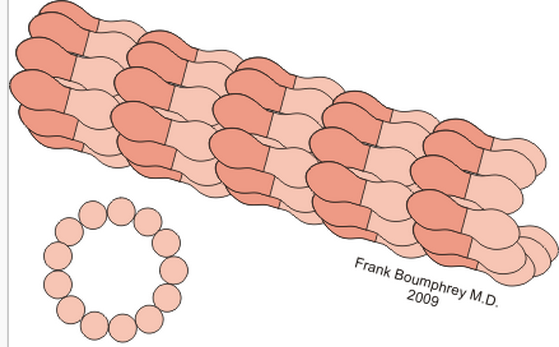
/Structure of a microtubule. The ring shape depicts a microtubule in cross-section,
showing the 13 protofilaments surrounding a hollow center. (Credit: Wikimedia Commons)/
A review and update
<http://www.sciencedirect.com/science/article/pii/S1571064513001188> of a controversial
20-year-old theory of consciousness published in Elsevier’s /Physics of Life
Reviews/ (open access) claims that consciousness derives from deeper-level, finer-scale
activities inside brain neurons.
The recent discovery of quantum vibrations in microtubules inside brain neurons
corroborates this theory, according to review authors Stuart Hameroff and Sir Roger
Penrose. They suggest that EEG rhythms (brain waves) also derive from deeper level
microtubule vibrations, and that from a practical standpoint, treating brain microtubule
vibrations could benefit a host of mental, neurological, and cognitive conditions.
Microtubules <http://en.wikipedia.org/wiki/Microtubule> are major components of the
structural skeleton of cells.
The theory, called “orchestrated objective reduction
<http://en.wikipedia.org/wiki/Orchestrated_objective_reduction>” (‘Orch OR’), was first
put forward in the mid-1990s by eminent mathematical physicist Sir Roger Penrose, FRS,
Mathematical Institute and Wadham College, University of Oxford, and prominent
anesthesiologist Stuart Hameroff, MD, Anesthesiology, Psychology and Center for
Consciousness Studies, The University of Arizona, Tucson.
*[+]* <http://www.kurzweilai.net/images/Microtubule-automaton.png>
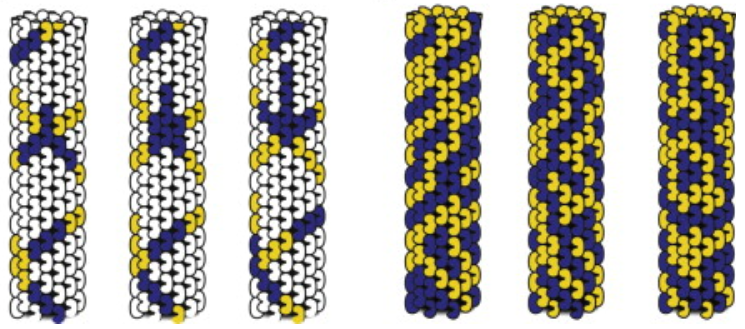
/Three time-steps (e.g. at 10 megahertz) of a microtubule automaton. Tubulin subunit
dipole states (yellow, blue) represent information. (Left three) Spin currents interact
and compute along spiral lattice pathways. For example (upper, middle in each
microtubule) two upward traveling blue spin waves intersect, generating a new vertical
spin wave (a “glider gun” in cellular automata). (Right three) A general microtubule
automata process. (Credit: P. Dustin, Microtubules, Springer-Verlag)/
They suggested that quantum vibrational computations in microtubules were “orchestrated”
(“Orch”) by synaptic inputs and memory stored in microtubules, and terminated by Penrose
“objective reduction” (‘OR’), hence “Orch OR.”
*Warm quantum coherence*
Orch OR was harshly criticized from its inception, as the brain was considered too
“warm, wet, and noisy” for seemingly delicate quantum processes. However, evidence has
now shown warm quantum coherence in plant photosynthesis, bird brain navigation, our
sense of smell, and brain microtubules.
The recent discovery of warm-temperature quantum vibrations in microtubules inside brain
neurons by the research group led by Anirban Bandyopadhyay, PhD, at the National
Institute of Material Sciences in Tsukuba, Japan (and now at MIT), corroborates the
pair’s theory and suggests that EEG rhythms also derive from deeper level microtubule
vibrations.
In addition, work from the laboratory of Roderick G. Eckenhoff, MD, at the University of
Pennsylvania, suggests that anesthesia, which selectively erases consciousness while
sparing non-conscious brain activities, acts via microtubules in brain neurons.
“The origin of consciousness reflects our place in the universe, the nature of our
existence. Did consciousness evolve from complex computations among brain neurons, as
most scientists assert? Or has consciousness, in some sense, been here all along, as
spiritual approaches maintain?” ask Hameroff and Penrose in the current review.
“This opens a potential Pandora’s Box, but our theory accommodates both these views,
suggesting consciousness derives from quantum vibrations in microtubules (protein
polymers inside brain neurons), which govern neuronal and synaptic function, and also
connect brain processes to self-organizing processes in the fine scale,
‘proto-conscious’ quantum structure of reality.”
After 20 years of skeptical criticism, “the evidence now clearly supports Orch OR,”
continue Hameroff and Penrose. “Our new paper updates the evidence, clarifies Orch OR
quantum bits, or “qubits,” as helical pathways in microtubule lattices, rebuts critics,
and reviews 20 testable predictions of Orch OR published in 1998 — of these, six are
confirmed and none refuted.”
*Hidden origins of EEG*
An important new facet of the theory is introduced. Microtubule quantum vibrations (e.g.
in the megahertz frequency range) appear to interfere and produce much slower EEG “beat
frequencies.” Despite a century of clinical use, the underlying origins of EEG rhythms
have remained a mystery. Clinical trials of brief brain stimulation — aimed at
microtubule resonances with megahertz mechanical vibrations using transcranial
ultrasound — have shown reported improvements in mood, and may prove useful against
Alzheimer’s disease and brain injury in the future.
Lead author Stuart Hameroff concludes, “Orch OR is the most rigorous, comprehensive and
successfully-tested theory of consciousness ever put forth. From a practical standpoint,
treating brain microtubule vibrations could benefit a host of mental, neurological, and
cognitive conditions.”
The review is accompanied by eight commentaries from outside authorities, including an
Australian group of Orch OR arch-skeptics. To all, Hameroff and Penrose respond robustly.
Penrose, Hameroff and Bandyopadhyay will explore their theories during a session on
“Microtubules and the Big Consciousness Debate” at the Brainstorm Sessions, a public
three-day event at the Brakke Grond in Amsterdam, the Netherlands, January 16-18, 2014
<http://www.brakkegrond.nl/programma/1253/Penrose_Bandyopadhyay_Hameroff/Lezing_Microtubuli_het_grote_debat_over_het_bewustzijn/#eng>.
They will engage skeptics in a debate on the nature of consciousness, and Bandyopadhyay
and his team will couple microtubule vibrations from active neurons to play Indian
musical instruments. “Consciousness depends on anharmonic vibrations of microtubules
inside neurons, similar to certain kinds of Indian music, but unlike Western music,
which is harmonic,” Hameroff explains.
/Full disclosure: I have collaborated with Jack Tuszynski, a co-author with Hameroff, in
developing patent applications related to microtubules. — Amara D. Angelica/
------------------------------------------------------------------------------------------

*Abstract of Consciousness in the universe: A review of the ‘Orch OR’ theory*
The nature of consciousness, the mechanism by which it occurs in the brain, and its
ultimate place in the universe are unknown. We proposed in the mid 1990ʼs that
consciousness depends on biologically ‘orchestrated’ coherent quantum processes in
collections of microtubules within brain neurons, that these quantum processes correlate
with, and regulate, neuronal synaptic and membrane activity, and that the continuous
Schrödinger evolution of each such process terminates in accordance with the specific
Diósi–Penrose (DP) scheme of ‘objective reduction’ (‘OR’) of the quantum state. This
orchestrated OR activity (‘Orch OR’) is taken to result in moments of conscious
awareness and/or choice. The DP form of OR is related to the fundamentals of quantum
mechanics and space–time geometry, so Orch OR suggests that there is a connection
between the brainʼs biomolecular processes and the basic structure of the universe. Here
we review Orch OR in light of criticisms and developments in quantum biology,
neuroscience, physics and cosmology. We also introduce a novel suggestion of ‘beat
frequencies’ of faster microtubule vibrations as a possible source of the observed
electro-encephalographic (‘EEG’) correlates of consciousness. We conclude that
consciousness plays an intrinsic role in the universe.
      REFERENCES:

  * Stuart Hameroff and Roger Penrose, Consciousness in the universe: A review
of the
    ‘Orch OR’ theory, Physics of Life Reviews, Aug. 20, 2013
    <http://www.sciencedirect.com/science/article/pii/S1571064513001188>


      RELATED:

  * Discovery of Quantum Vibrations in “Microtubules” Inside Brain Neurons
Corroborates
    Controversial 20-Year-Old Theory of Consciousness

<http://3blmedia.com/News/Health/Discovery-Quantum-Vibrations-Microtubules-Inside-Brain-Neurons-Corroborates>

*Topics:* Cognitive Science/Neuroscie
--
You received this message because you are subscribed to the Google Groups
"Everything List" group.
To unsubscribe from this group and stop receiving emails from it, send an email
to [email protected].
To post to this group, send email to [email protected].
Visit this group at http://groups.google.com/group/everything-list.
For more options, visit https://groups.google.com/groups/opt_out.