On Tuesday, 23 April 2019 09:52:14 UTC+3, telmo wrote:
>
> On Fri, Apr 19, 2019, at 21:35, 'Cosmin Visan' via Everything List wrote:
>
> 1) You raise an interesting point. Can you give another example in that
> direction beside the qualia of good and bad ? Because you made me think
> about the case that you mentioned, and it seems to me that it only works
> for cases of good and bad. A similar example to yours would be: blue and
> green emerge on top of shades-of-gray, but I like blue and I don't like
> green, so where does the good and bad appear in my final experience of a
> quale ? So it might be the case that aesthetic components might be
> something special. That's why I would like to hear if you can come up with
> a similar example besides aesthetic components, to pinpoint more precisely
> where there might be a problem with my ideas about emergence.
>
>
> People describe colors as "warm" and "cold", and alcoholic beverages as
> "fiery". Another thing that occurs to me are the classical elements: water,
> air, fire, earth. Also the fact that separate cultures believed at some
> point in similar sets of elemental substances.
>
I think these cases (also the ones with good/bad) are about consciousnesses
unifications. Is the same with our senses: we are 1 consciousness that both
sees and hears. Probably what is happening is that "initially" there are 2
individual consciousnesses: one that only sees, other that only hears, and
then they are unified into 1 consciousness. This can also be explained by
self-reference looking-back-at-itself and including in itself 2 of its
previous manifestations. The same unification also probably happens in
telepathies. Personally, I don't see telepathy as message exchange, but as
unification of consciousnesses into one, having a common experience and
then breaking apart again. Of course, the problem remains what controls
these unifications.

>
>
> 3) There is no ontological/epistemological confusion here. I state that
> even if you are to take into account the entire history that you mention,
> the electron would still not follow the same laws as in simple systems,
> because in the brain it will receive top-down influence from a higher
> consciousness.
>
>
> My counter-argument is that the laws remain exactly the same, but they
> become impossible to apply in practice because one would have to know the
> value of too many variables, and with too much precision. Are you familiar
> with chaos theory?
>
> I am familiar, but I really do think that is genuine novelty involved in
consciousness. When you have a new experience, this is not just a result of
"rearranging atoms", but is truly something new that never existed before.
And from that new state of consciousness you will start to impact the world
in different ways that are not understood by consciousnesses on lower
levels. Imagine a blind person and a seeing person taking part in a race.
Immediately when that race starts, the seeing person will get away rapidly
from the blind person. The blind person can wonder all day long how can the
seeing person move his body so rapidly without bumping into stuff. The
reason is that the seeing person is on a higher level of consciousness that
gives him new understandings of the world and enable him to act upon the
world in ways that are totally beyond any comprehension of consciousnesses
on lower levels. "Laws of physics" are just statistical behaviours of
primitive "electrons" and "protons" that all that they know is to circle
one another. But when those primitive consciousnesses are emerged upon in
complex systems such as the brain, the electrons will start doing other
things, like going in the muscles in specific places as to follow the will
of the higher consciousness.

> And the more complex the system, the more the consciousness is evolved and
> its intentions are beyond comprehension, so the ability to describe the
> movement of electrons using coherent laws vanishes. The electron will
> simply appear to not follow any law, because the intentions of
> consciousness would be more and more complex and diverse.
>
>
> I follow several things that you say with no problem. My biggest point of
> disagreement is with the type of statements like the one above, these ideas
> of an "interactive consciousness" that I find reminiscent of the interface
> problem: if consciousness is not matter, then how does it interact with
> matter?
>
> I am more inclined towards explanations where consciousness is the stage
> itself, not one of the actors.
>
>
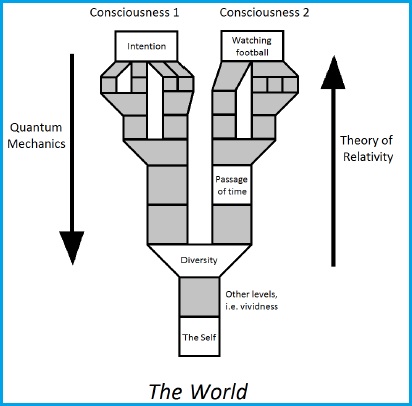
But there is no interaction with matter. I give in the book a model of how
interactions can take place, and that is through the tree of emergence.
Each consciousness can only act upon itself, but because all the
consciousnesses in the world are connected through the tree of emergence
which has the Self at the root, one act of a consciousness upon itself is
then felt in other consciousnesses, because it will get to influence common
levels.

<https://jcer.com/public/journals/2/cover_issue_84_en_US.jpg>

--
You received this message because you are subscribed to the Google Groups
"Everything List" group.
To unsubscribe from this group and stop receiving emails from it, send an email
to [email protected].
To post to this group, send email to [email protected].
Visit this group at https://groups.google.com/group/everything-list.
For more options, visit https://groups.google.com/d/optout.