On 18 Jun 2010 at 13:07, John Howell wrote:

> At 10:29 PM -0400 6/17/10, David W. Fenton wrote:
> >Yes, of course. I never had a proper course in graduate school on the
> >notation of this period -- I've learned what I know only by doing it
> >myself!
>
> That's the only way you CAN learn it, even if you took the Early
> Notation course!  And when it comes to the late Medieval stuff I have
> to RE-learn it whenever I get involved in it again.
When you say "it" you mean one of the many notational dialects,
Mensural, Garlandian, Franconian, etc. When I got to the point that I
could tell the difference by looking, and even see Garlandian
notation copied by a Franconian (so that Franconian aspects got
haphazardly placed in the basic Garlandian notation), I knew I'd
absorbed it.

But that was almost 20 years ago, and, heavens, I don't know if I
could do it any longer.

>  Although teaching
> it does help me keep it straight.  The challenge is finding examples
> that are clear cut enough to make sense for beginners.

The early medieval notation is frightfully difficult, since up to
Franco, any particular symbol derives its rhythmic meaning from
context, and that means it's ambiguous.

> >It was left out of my grad school training because, I think,
> >there was an assumption that the notation is "just the same as modern
> >notation," which is bollocks, of course! Throw that coloration (see
> >the last page, for instance) at someone familiar only with a modern
> >notation and see what they come up with!
> >
> >That does raise the question if you think that I've handled the
> >coloration correctly. I would have liked to have used tuplets, but in
> >this particular meter, I just think it would have confused things, so
> >I wrote out the literal note values, instead. It seems perfectly
> >clear to me.
>
> Without seeing what the original looks like it's hard to judge, but
> what you have certainly works musically even though it's a child's
> garden of hemiola!

It's really quite nice rhythmically, though I'm sure some of the
players' heads will explode trying to make it fit together.

BTW, the only recording I've found is this one:

  http://www.amazon.com/gp/product/B001KUCY62

It's pretty nice, actually, though I don't agree entirely with their
interpretations of affect/tempo in all the sections. If anyone
downloads the tracks (they are 99¢ each, so $5 for this piece), can
you listen to it with the score to see if they are, indeed,
interpreting the coloration the same as I've done (the last track,
#11, Was schadet mir, is the one with all the follies at the end)? I
have it really strongly in my ear from having worked on it, and what
they do sounds to me like exactly what I've notated (though I can't
really hear what they do with the inner parts in the penultimate
measure that Howard questioned).

> I wonder about repeating the 3/2 time signature in
> the final bar, though, since that's part of the 9/2 pattern.  And of
> course the longa is treated the same as a fermata--just an indication
> that "th, th, th, that's all, folks"!

I wasn't sure how to handle that. In fact, in the original, it's
actually a pair of longs, but I thought better of putting in two and
tying them together -- they were so imprecise with this that I think
slavish transription of exactly what they wrote implies a precision
that isn't there. They obviously wanted a big long note at the end,
one that is not part of the meter of the measure to which it is
attached (or more strictly speaking, a massive lengthening of the
final measure).

I'm not sure my 1st/2nd ending is strictly Kosher, but I don't think
it's confusing, either. To be really precise, the first ending would
have to be a 9/2 measure, and the second ending a 6/2 measure
followed by an 8/2 measure (two longs).

Of course, I vaguely recall that the tail on the long changes the
value or something? And this pair of longs has the tails between
them:


   o   o
    | |

(that's the best I can do in ASCII!)

...and I now notice a fermata beneath the two flags.


Oops, no, the double longs are only in the instruments. The organ and
the voices have but a single long, so I think my solution is probably
best, since I took the barring from the organ part.

> Was that REAL coloration, black notes replacing white notes?  The
> traditional meaning is duple time, of course, so that certainly works,
> but in 1660?  That IS unusual!!!  A tuplet would work, but I think your
> solution is less confusing.

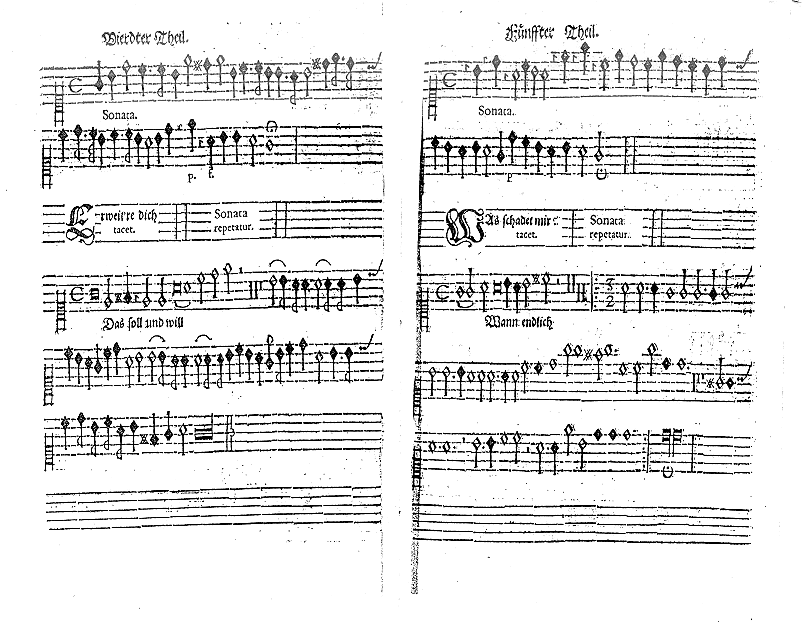
It's definitely real coloration (see my reply to Howard Wiener), with
a white semi-breve and two colored semi-breves in the time of a
dotted breve. I've seen cadential coloration like this in Charpentier
MSS, too, but I didn't understand it at the time and mistranscribed
it.

And, yes, it's pretty darned late!

Here's the last two pages of the first viol part:

  http://dfenton.com/images/Capricornus-ColorationV1.png

If you see anything there in regard to coloration that you think is
wrong in my interpretation, do let me know!

--
David W. Fenton                    http://dfenton.com
David Fenton Associates       http://dfenton.com/DFA/


_______________________________________________
Finale mailing list
[email protected]
http://lists.shsu.edu/mailman/listinfo/finale