On 18 Jun 2010 at 15:56, John Howell wrote:

> At 3:12 PM -0400 6/18/10, David W. Fenton wrote:
> >
> >The early medieval notation is frightfully difficult, since up to
> >Franco, any particular symbol derives its rhythmic meaning from
> >context, and that means it's ambiguous.
>
> Well, it's dead easy as long as they follow their own rules, but they
> have a nasty habit of breaking the mode near a cadence that then
> everything's up for grabs!
But it's not that easy in the early mensural notation and the
Garlandian.

I think it's interesting that the fluidity of cadential rhythm
persisted all the way into the Baroque. There's lots of interesting
stuff going on cadentially in the Parisian Organum repertory, for
instance (not so much rhythmically, but in terms of melodic
formulae), and this seems to be one aspect of musical style (i.e.,
rhythmic/metrical marking of cadences) that persists for a very long
period.

> >They obviously wanted a big long note at the end,
> >one that is not part of the meter of the measure to which it is
> >attached (or more strictly speaking, a massive lengthening of the
> >final measure).
>
> Yes, and that last bar seems to be a bit of overkill!

In the original, or in my edition? I thought about leaving it out
entirely and doing the job with a fermata, but don't think that has
the same effect.

> >I'm not sure my 1st/2nd ending is strictly Kosher, but I don't think
> >it's confusing, either. To be really precise, the first ending would
> >have to be a 9/2 measure, and the second ending a 6/2 measure
> >followed by an 8/2 measure (two longs).
>
> I think it's Kosher because it makes both endings fit the same
> rhythm, which certainly works for me.

It seems the simplest solution to me.

> >Of course, I vaguely recall that the tail on the long changes the
> >value or something? And this pair of longs has the tails between
> >them:
>
> That's a lot earlier.

Hence, my question, since that's the notational period I have solid
training in.

> Seeing the original makes it obvious that they
> are following a convention that stems on notes on the middle line go
> up, the opposite of the modern convention, but it's consistent.  And
> applied more to ligatures in earlier times than individual notes.
> Stems on individual longs always went down, just as stems on minims
> always went up.

I noticed that it's pretty consistent in this edition.

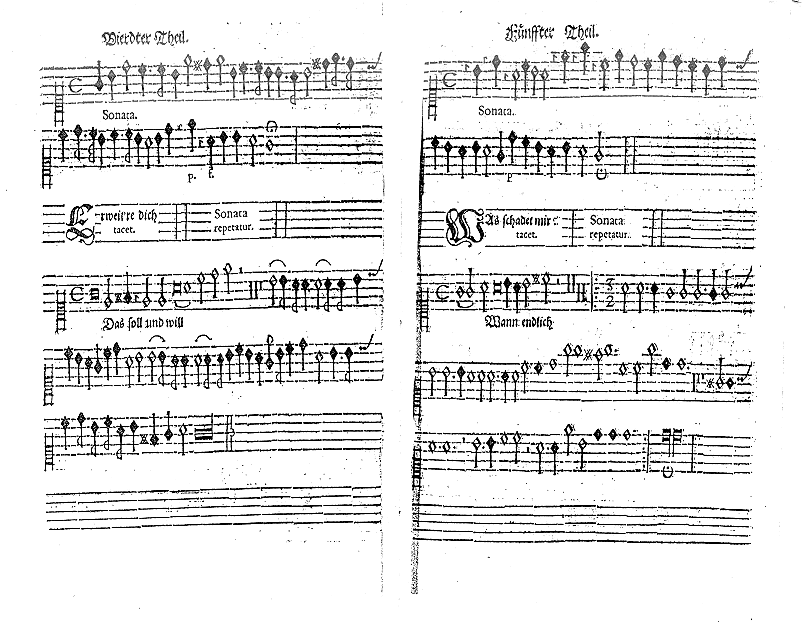
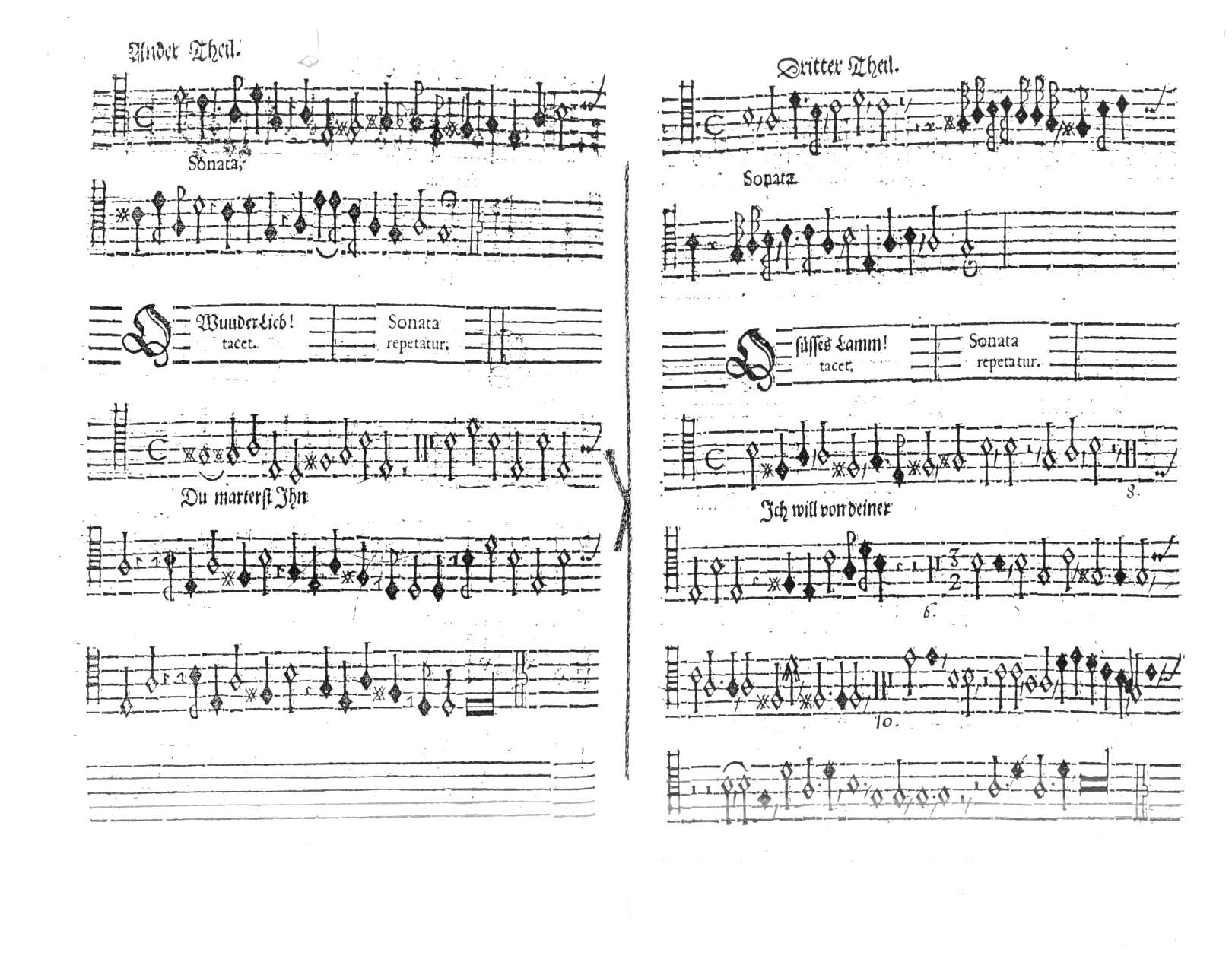
> >Here's the last two pages of the first viol part:
> >
> >   http://dfenton.com/images/Capricornus-ColorationV1.png
> >
> >If you see anything there in regard to coloration that you think is
> >wrong in my interpretation, do let me know!
>
> OK, with that to look at, I do think I would interpret it
> differently, and actually more simply.  I would probably keep the two
> minims as half notes (E5, A4), then treat the two black semibreves as
> actual imperfect semibreves worth 2 minims each (2 modern whole
> notes), and the first cadence note as a regular dotted semibreve
> (worth 3 minims).

That makes much more sense and doesn't require the old-fashioned
alteration of the length of the semi-breve that comes before the
coloration. And now that I listen to the recording again, it seems
clear they did it that way.

I just overcomplicated things by thinking like a Medievalist.

>  I didn't quite understand what you meant about the
> coloration changing the value of the notes BEFORE it, since that's
> something I've never come across.  But this interpretation gives a
> very nice and very standard hemiola preceding the final cadence note,
> in a nice cross rhythm with each of the vocal parts, which are already
> in cross rhythms with each other.

It's a much simpler interpretation, and I've changed my score to use
this one (which is undoubtedly correct). It does raise one notational
question for me, and that's how wide the coloration brackets should
be? Should they be as long as the entire note value, or just as wide
as the notes they apply to (as I've actually done it)?


This interpretation does require one oddity, and that's in m. 145 in
Bass I, where in the part for that measure is a half rest, a dotted
minim, a colored semi-breve, a dotted minim and a semi-minim. If the
colored semi-breve is interpreted as a whole note, it means there's
an extra semi-minim (in modern terms, there's only room for a dotted
half (as in the score), instead of a whole).

The fascinating thing is that the copy I'm working from (I don't know
its exact pedigree -- I assume it's from a microfilm -- someone else
took care of finding the original source!) has been used in the past
by somebody who has marked it with strokes to delineate the semi-
breves:

  http://dfenton.com/images/Capricornus-ColorationV4.png

Now, I can confirm that the semi-breves are correctly counted, but I
don't know how to interpret that except as I've done it in the score.

Any suggestions?

> But that doesn't mean I'm right or you're wrong.  It's just the first
> thing I would try, and the note values do work out even though they
> are not 4 notes of equal length.

It works beautifully, and is much more natural.

> Interesting that in the absence of bar lines, the engraver (or more
> likely typesetter) used tied notes rather than dotted notes.  It looks
> really weird in this repertoire!

The note values are quite uniformly broken at the semi-breve. That
is, in 4/2, notes don't cross from the 2nd to 3rd beats without a
tie. I really can't say why they chose not to include barlines in
anything but the bass, as the note values themselves conform with the
barlines (and modern standards for dividing beats!).

> I'd love to give one of these a try, although it would have to be with
> violins rather than viols.  I think I'll have the right people for it,
> but I never know until the semester starts.

If you want to use it let me know. I'd be thrilled to have someone
else using this edition. There's still a lot of work to do, and I'll
be preparing parts, with a full score that omits the Bass II part and
the blank continuo scratch staff, and then a part for the organist
that includes that scratch staff, and then a part for the continuo
bass player that includes the singers' lines.

Finale makes all of this quite difficult. I'm using an old version of
Finale and don't have linked parts, but I don't think they'd do me
much good! I wish special part extraction was able to save different
layouts for later retrieval, though.

And I'm having fits with optimization, and system margins and page
text. I expect all of those would be much easier in Sibelius, but
everything else would take me 4 times as long!

--
David W. Fenton                    http://dfenton.com
David Fenton Associates       http://dfenton.com/DFA/

_______________________________________________
Finale mailing list
[email protected]
http://lists.shsu.edu/mailman/listinfo/finale