At 5:25 PM -0400 6/18/10, David W. Fenton wrote:
On 18 Jun 2010 at 15:56, John Howell wrote:
 At 3:12 PM -0400 6/18/10, David W. Fenton wrote:
 >
 >The early medieval notation is frightfully difficult, since up to
 >Franco, any particular symbol derives its rhythmic meaning from
 >context, and that means it's ambiguous.

 Well, it's dead easy as long as they follow their own rules, but they
 have a nasty habit of breaking the mode near a cadence that then
 everything's up for grabs!
But it's not that easy in the early mensural notation and the
Garlandian.
Your comment drove me to New Grove, since I sort of skip over
Johannes in my lectures on 13th century notation, but now I realize
how important his ideas were, both as the theoretical explanation of
the Notre Dame modes (although he carried further than they
apparently had) and as the source for a number of Franco's new ideas
AND ideas about consonance and dissonance which I've been using for
years without knowing their source. Fascinating.
> >They obviously wanted a big long note at the end,
 >one that is not part of the meter of the measure to which it is
 >attached (or more strictly speaking, a massive lengthening of the
 >final measure).

 Yes, and that last bar seems to be a bit of overkill!
In the original, or in my edition? I thought about leaving it out
entirely and doing the job with a fermata, but don't think that has
the same effect.
Oh, in the original. And it isn't even consistent, since in pieces 4
& 5 a duplex long is used for one and two longs, back to back, WITH a
fermata in the other. Not that we can automatically assume that the
fermata meant the same thing to them that it means to us, of course.
The sign itself goes back to the 13th or 14th centuries as one of
several "signa conguentia" or signs of coming together, especially in
the very early instrumental pieces.
It's a much simpler interpretation, and I've changed my score to use
this one (which is undoubtedly correct). It does raise one notational
question for me, and that's how wide the coloration brackets should
be? Should they be as long as the entire note value, or just as wide
as the notes they apply to (as I've actually done it)?
What I've been taught (or perhaps just what I've absorbed) is to use
the full bracket for ligatures to indicate the notes that are bound
together. And that makes good sense, since the ligature in most
cases served much as a slur serves us to indicate a single syllable
of text. But to use a broken bracket (i.e. with an empty space in
the middle) to indicate coloration, and then it would embrace only
the colored notes themselves. This is what Alan Atlas does in the
transcription project that's built into his textbook, "Renaissance
Music," which uses 2 ms. versions of a 15th century chanson in white
notation. The only use of coloration in those examples are for what
he calls "minor color"--a black semibreve followed by a black
minim--which he suggests transcribing as a dotted quarte + eighth.
(And sometimes the black semibreve is the second note of a ligature,
and in that case it's the rising stem on the left of the FIRST note
that makes both notes semibreves "with opposite propriety"!)
This interpretation does require one oddity, and that's in m. 145 in
Bass I, where in the part for that measure is a half rest, a dotted
minim, a colored semi-breve, a dotted minim and a semi-minim. If the
colored semi-breve is interpreted as a whole note, it means there's
an extra semi-minim (in modern terms, there's only room for a dotted
half (as in the score), instead of a whole).
Yes, I can see the problem. Of course errors are always possible,
and the context makes me wonder whether that minim rest might have
been miscopied and was supposed to be a semi-minim rest, since the
values of the notes themselves seem pretty unambiguous.
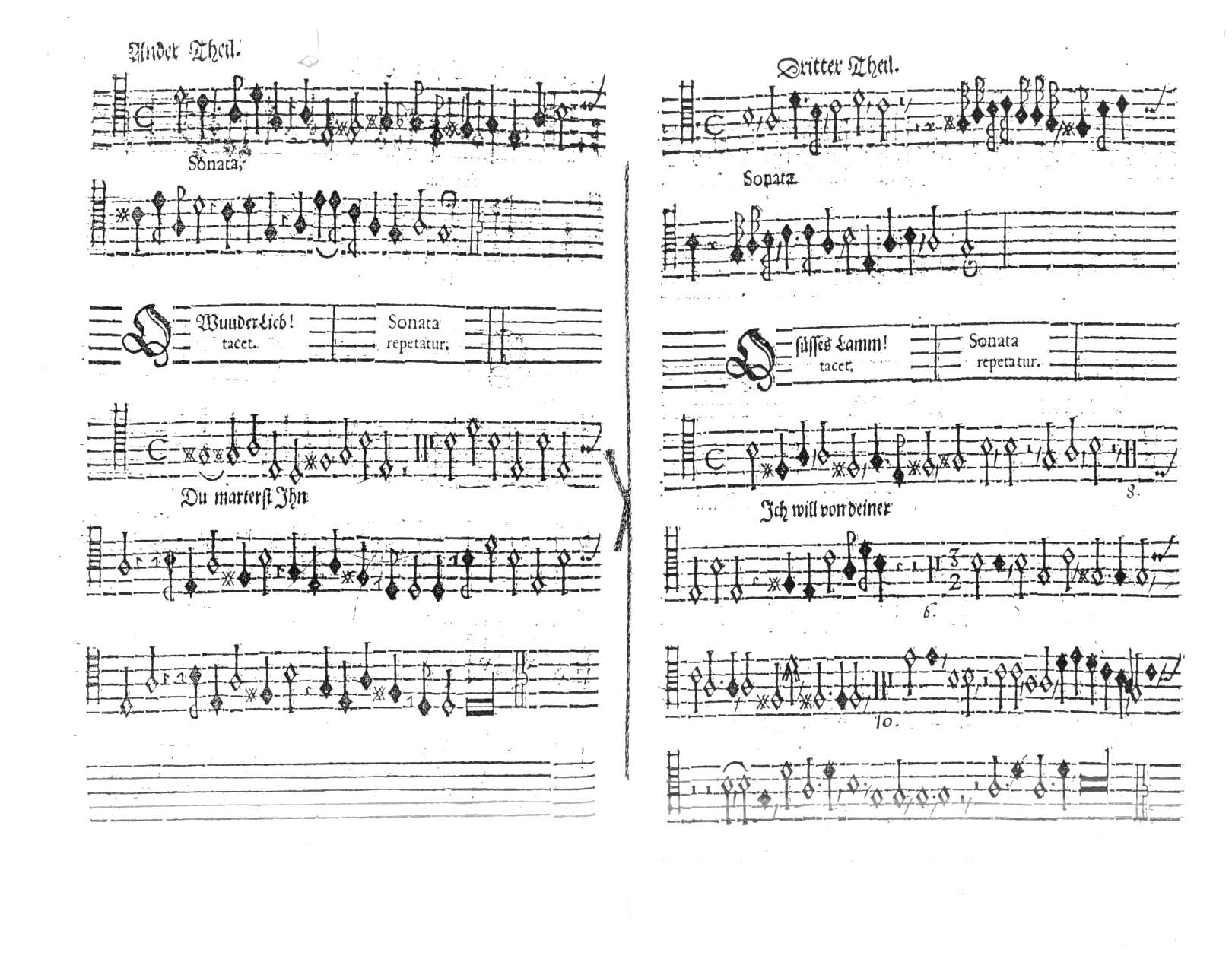
The fascinating thing is that the copy I'm working from (I don't know
its exact pedigree -- I assume it's from a microfilm -- someone else
took care of finding the original source!) has been used in the past
by somebody who has marked it with strokes to delineate the semi-
breves:

  http://dfenton.com/images/Capricornus-ColorationV4.png
Hah! I've had students do the same thing in transcription
projects--in fact I recommend it to them!
> Interesting that in the absence of bar lines, the engraver (or more
 likely typesetter) used tied notes rather than dotted notes.  It looks
 really weird in this repertoire!
The note values are quite uniformly broken at the semi-breve. That
is, in 4/2, notes don't cross from the 2nd to 3rd beats without a
tie. I really can't say why they chose not to include barlines in
anything but the bass, as the note values themselves conform with the
barlines (and modern standards for dividing beats!).
Or Franconian standards of always thinking in perfections! Which of
course goes back to Notre Dame via Garlandia.
 I'd love to give one of these a try, although it would have to be with
 violins rather than viols.  I think I'll have the right people for it,
 but I never know until the semester starts.
If you want to use it let me know. I'd be thrilled to have someone
else using this edition. There's still a lot of work to do, and I'll
be preparing parts, with a full score that omits the Bass II part and
the blank continuo scratch staff, and then a part for the organist
that includes that scratch staff, and then a part for the continuo
bass player that includes the singers' lines.
I would indeed like to give one of these 5 pieces a try. I should
have the sopranos, and my string players are pretty good if not
virtuosic. I would use harpsichord rather than organ. I think.
Although come to think of it, we do have a small organetto that can
sound surprisingly good on continuo even though it doesn't descend
below middle C, as long as the bass line is covered on a stringed
instrument.
Please let me know when you have something available. I would need
PDFs, since I am not currently using Finale. Are these sacred texts?
My German isn't up to attempting a translation.
And I'm having fits with optimization, and system margins and page
text. I expect all of those would be much easier in Sibelius, but
everything else would take me 4 times as long!
As David Bailey has said many times, you should use what will do the
job for you!
John


--
John R. Howell, Assoc. Prof. of Music
Virginia Tech Department of Music
College of Liberal Arts & Human Sciences
Blacksburg, Virginia, U.S.A. 24061-0240
Vox (540) 231-8411  Fax (540) 231-5034
(mailto:[email protected])
http://www.music.vt.edu/faculty/howell/howell.html

"We never play anything the same way once."  Shelly Manne's definition
of jazz musicians.
_______________________________________________
Finale mailing list
[email protected]
http://lists.shsu.edu/mailman/listinfo/finale