On 18.06.2010 21:56, John Howell wrote:
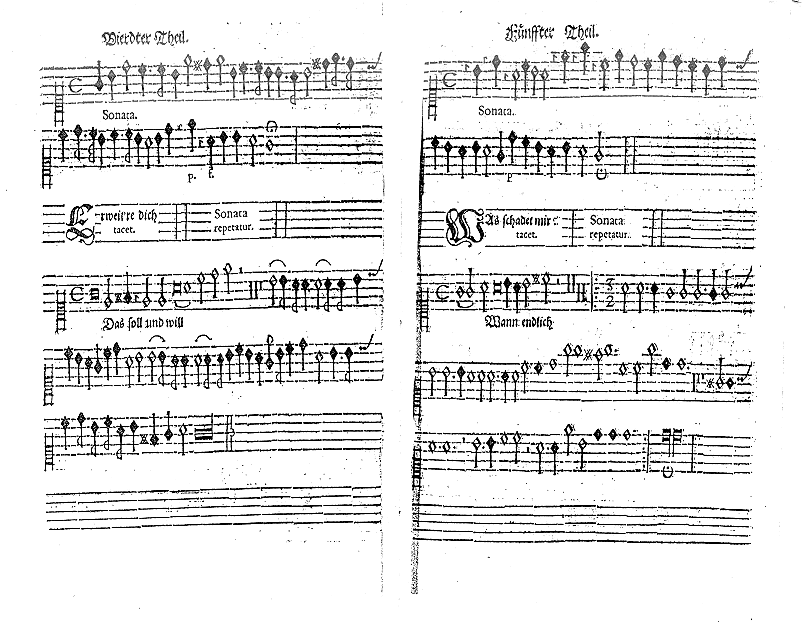
Here's the last two pages of the first viol part:

  http://dfenton.com/images/Capricornus-ColorationV1.png

If you see anything there in regard to coloration that you think is
wrong in my interpretation, do let me know!
OK, with that to look at, I do think I would interpret it differently,
and actually more simply. I would probably keep the two minims as
half notes (E5, A4), then treat the two black semibreves as actual
imperfect semibreves worth 2 minims each (2 modern whole notes), and
the first cadence note as a regular dotted semibreve (worth 3
minims). I didn't quite understand what you meant about the
coloration changing the value of the notes BEFORE it, since that's
something I've never come across. But this interpretation gives a
very nice and very standard hemiola preceding the final cadence note,
in a nice cross rhythm with each of the vocal parts, which are already
in cross rhythms with each other.
Exactly what I was saying! Now it looks right, except for two things:
you might want to recheck the rhythm of Bass 1 in measure 145, and the
first ending should start after the f-sharp half note in soprano 2,
i.e., the final note of the phrase should clearly come on the beat in
both endings.
Concerning the extended final measures of the various sections, I would
do one of two things: either rebar using smaller measures throughout the
piece, which would automatically solve the problem and can actually be
justified for music of this late date, or leave out the "new" time
signature and add a mensurstrich to divide the extended measure into a
"full" measure and a "half" measure, which would get rid of the anomaly
of having music in duple meter with a triple-meter time signature.
Howard

--
Howard Weiner
[email protected]
http://howard-weiner.de/

Help stamp out and eradicate superfluous redundancy

_______________________________________________
Finale mailing list
[email protected]
http://lists.shsu.edu/mailman/listinfo/finale