At 3:12 PM -0400 6/18/10, David W. Fenton wrote:
The early medieval notation is frightfully difficult, since up to
Franco, any particular symbol derives its rhythmic meaning from
context, and that means it's ambiguous.
Well, it's dead easy as long as they follow their own rules, but they have a nasty habit of breaking the mode near a cadence that then everything's up for grabs!
They obviously wanted a big long note at the end,
one that is not part of the meter of the measure to which it is
attached (or more strictly speaking, a massive lengthening of the
final measure).
Yes, and that last bar seems to be a bit of overkill!
I'm not sure my 1st/2nd ending is strictly Kosher, but I don't think
it's confusing, either. To be really precise, the first ending would
have to be a 9/2 measure, and the second ending a 6/2 measure
followed by an 8/2 measure (two longs).
I think it's Kosher because it makes both endings fit the same rhythm, which certainly works for me.
Of course, I vaguely recall that the tail on the long changes the
value or something? And this pair of longs has the tails between
them:
That's a lot earlier. Seeing the original makes it obvious that they are following a convention that stems on notes on the middle line go up, the opposite of the modern convention, but it's consistent. And applied more to ligatures in earlier times than individual notes. Stems on individual longs always went down, just as stems on minims always went up.
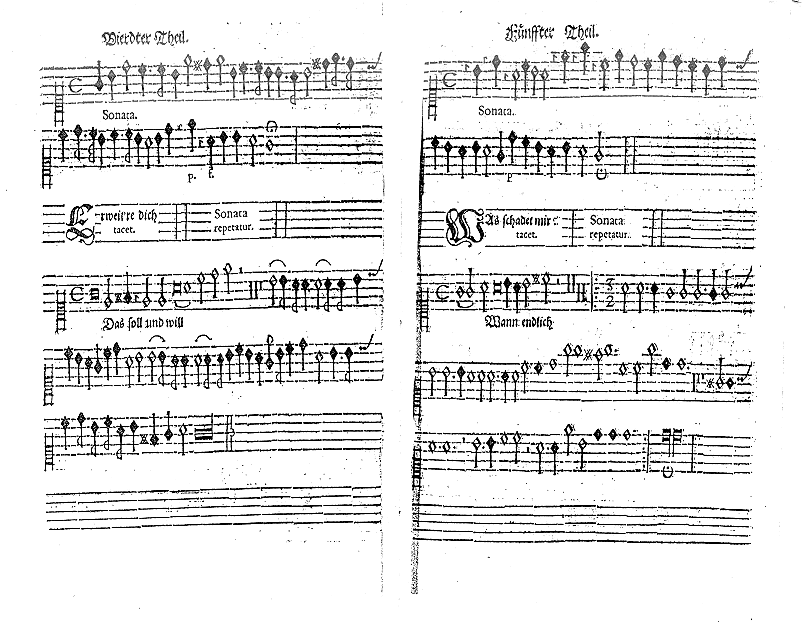
Here's the last two pages of the first viol part:

  http://dfenton.com/images/Capricornus-ColorationV1.png

If you see anything there in regard to coloration that you think is
wrong in my interpretation, do let me know!
OK, with that to look at, I do think I would interpret it differently, and actually more simply. I would probably keep the two minims as half notes (E5, A4), then treat the two black semibreves as actual imperfect semibreves worth 2 minims each (2 modern whole notes), and the first cadence note as a regular dotted semibreve (worth 3 minims). I didn't quite understand what you meant about the coloration changing the value of the notes BEFORE it, since that's something I've never come across. But this interpretation gives a very nice and very standard hemiola preceding the final cadence note, in a nice cross rhythm with each of the vocal parts, which are already in cross rhythms with each other.
But that doesn't mean I'm right or you're wrong. It's just the first thing I would try, and the note values do work out even though they are not 4 notes of equal length.
Interesting that in the absence of bar lines, the engraver (or more likely typesetter) used tied notes rather than dotted notes. It looks really weird in this repertoire!
I'd love to give one of these a try, although it would have to be with violins rather than viols. I think I'll have the right people for it, but I never know until the semester starts.
John


--
John R. Howell, Assoc. Prof. of Music
Virginia Tech Department of Music
College of Liberal Arts & Human Sciences
Blacksburg, Virginia, U.S.A. 24061-0240
Vox (540) 231-8411  Fax (540) 231-5034
(mailto:[email protected])
http://www.music.vt.edu/faculty/howell/howell.html

"We never play anything the same way once."  Shelly Manne's definition
of jazz musicians.
_______________________________________________
Finale mailing list
[email protected]
http://lists.shsu.edu/mailman/listinfo/finale